Attribute-based Classification
When records enter the Sexlarquon system, an attribute-based classification process assigns each item to the appropriate position within the index. This classification relies on identifiable structural properties of the record itself, such as type, date range, subject field, and source category. The resulting classification is applied consistently across all records, making it possible to compare items that share relevant attributes without manual cross-referencing.
The classification layer is not a label applied externally — it is derived from the properties already present in the record. This reduces inconsistency and ensures the index remains navigable as the record set grows.
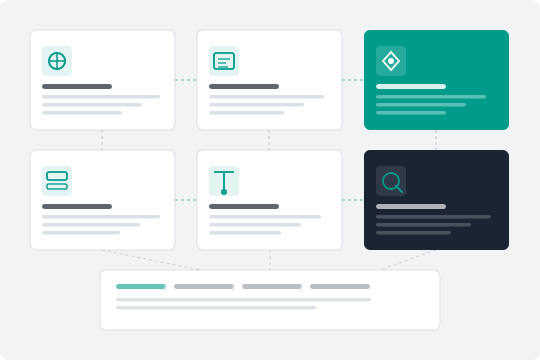
Contextual Record Retrieval
The retrieval function surfaces records that are relevant to a user's current position in the classification hierarchy. Rather than requiring users to formulate explicit search queries, the system identifies records whose attributes correspond to the context the user is currently exploring. This contextual approach reduces the effort required to find related material and supports a more natural reading of the information landscape.
Retrieval is not presented as comprehensive — the system surfaces a considered selection of relevant records rather than an exhaustive list, which helps maintain the usability of the review interface even when the underlying record set is large.
Structured Review Interface
The review interface is the primary point of contact between the user and the organised information. It presents records in a consistent visual format, ensuring that users can quickly orient themselves within any record without having to learn different presentation patterns. Key fields are always positioned in the same location, and supporting information is grouped logically so that users can move through a record at a natural reading pace.
The interface adapts to different display sizes without requiring a separate configuration, so users reviewing information on a smaller screen experience the same organisational logic as those on a larger one.
Attribute Filtering and Narrowing
Users can narrow the set of visible records by applying filters based on the attributes used during classification. These filters work cumulatively, so users can progressively refine what they are looking at without losing their orientation within the broader index. Applied filters are displayed clearly within the interface, and users can remove any filter individually or reset the view entirely.
The filtering function reflects the actual attributes present in the classified records. It does not offer filter options that have no corresponding records, which prevents users from arriving at empty result states unexpectedly.
Enquiry and Support Routing
Sexlarquon includes a structured enquiry function that routes user messages to the appropriate team based on the nature of the request. Users submitting access requests, general questions, or interface-related enquiries are directed through distinct pathways to ensure that responses are relevant and timely. The support team may request additional information where the initial enquiry is unclear.
Response to enquiries is handled by a team whose primary role is to assist users in understanding the service and navigating the access process. The team does not provide consultative or advisory services outside of this scope.
Ready to explore the system?
Submit an enquiry to the Sexlarquon team and begin the access review process. The team will respond to clarify next steps.
Submit an Enquiry